Showing posts with label Research. Show all posts
Showing posts with label Research. Show all posts
Sunday, 1 March 2015

Tuesday, 13 January 2015
Tuesday, 9 December 2014
Secondary Research - Inspiration for Effects
The following link is my groups source of secondary evidence. It is a short clip from Youtube titled 'Im Never Turning The Lights Off Again'. Throughout the clip a series of interesting effects are used. As a group we decided these were the sorts of effects we could incorporate within are thriller opening piece.
https://www.youtube.com/watch?v=vzJCoJVgKA8
https://www.youtube.com/watch?v=vzJCoJVgKA8
Monday, 8 December 2014
Lighting Effects
We decided to play about with lighting within our group. We tried to use un natural lighting in a dark room to give the character a rather sinister look.

In this photo it shows the character (Frank) with the un natural light source shining on the right side of his face showing his facial expressions. Whereas on the right side of his face there is no light and therefore creates a mysterious and sinister effect. We may consider using this effect in our thriller. Also in this photo the lighting creates a shadow effect in the background, this was not intentional however is a technique we could look into using.

In this photo we decided to put the un natural light so it was shining under the chin of our character (Frank) this created the sinister effect we were looking for as it shows all facial expressions but doesn't give off any of the background. This again is a technique we may consider using in our thriller.
In this photo it shows the character (Frank) with the un natural light source shining on the right side of his face showing his facial expressions. Whereas on the right side of his face there is no light and therefore creates a mysterious and sinister effect. We may consider using this effect in our thriller. Also in this photo the lighting creates a shadow effect in the background, this was not intentional however is a technique we could look into using.
In this photo we decided to put the un natural light so it was shining under the chin of our character (Frank) this created the sinister effect we were looking for as it shows all facial expressions but doesn't give off any of the background. This again is a technique we may consider using in our thriller.
Wednesday, 26 November 2014
The Effects of Cut-a-Ways
Effects of cut aways
We have done this post to show how different techniques can change the ways in which certain scenes can be perceived. One scene could be seen as a different genre depending on what ios to follow, it can create a different emotion.

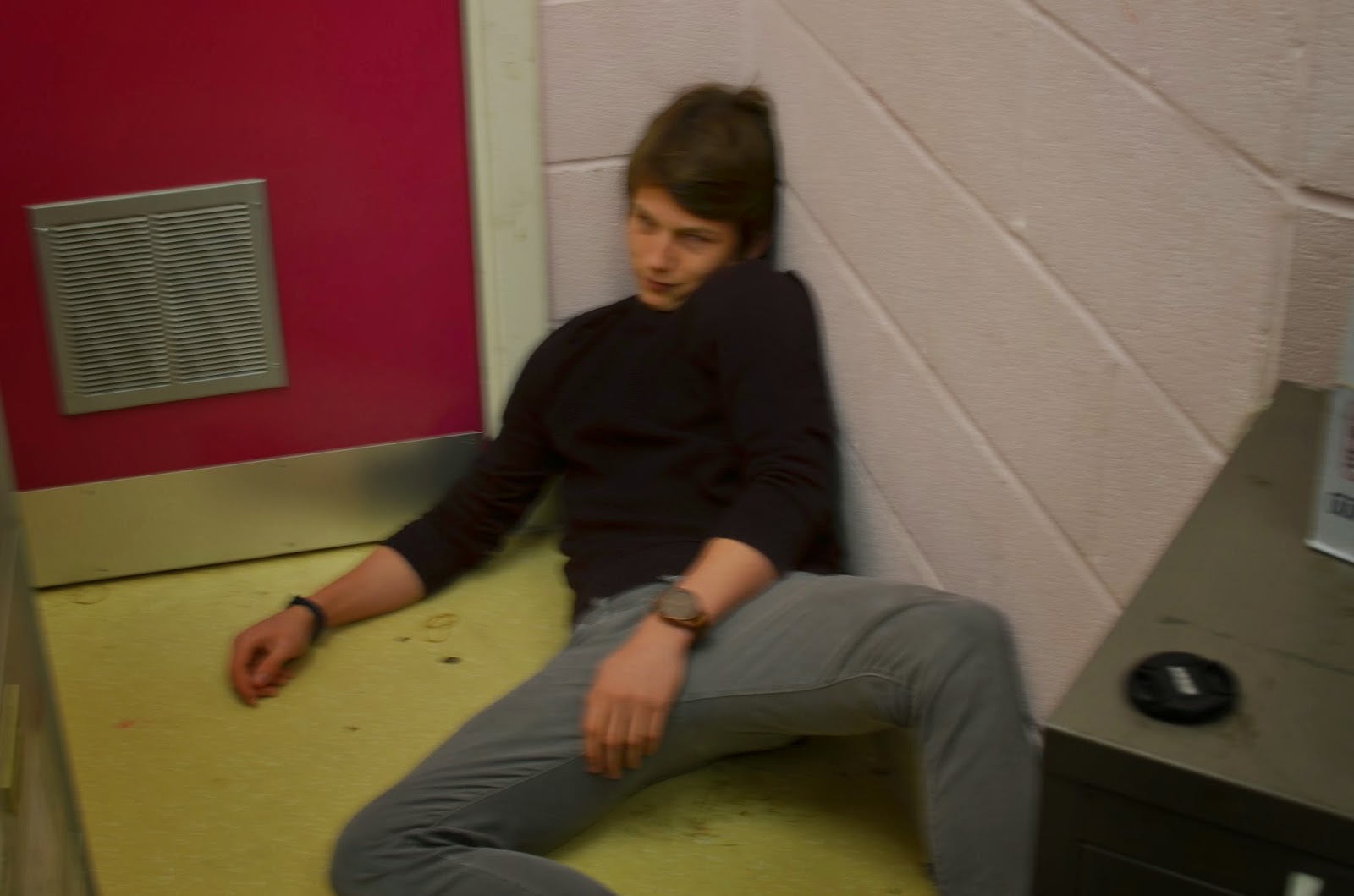
This use of a cut away above makes the character on the left look crazy and sinister with the character smirking at a dead body. However the cut away below shows a characters reaction to another character making a funny face which makes the scene much more comedic and funny.

Sunday, 9 November 2014
Conventions of Thriller Films
Conventions of Thriller
Films
A broad genre of literature, film, gaming and television. It includes
numerous, often overlapping sub-genres
Typical Features
·
Low key lighting
·
Quick cut
·
Shadows
·
Tension music
·
Changes in angle of shot
·
Diegetic sound of breathing
·
Black and white shots
·
Montage of shots
·
Protagonist is at the mercy of the Antagonist
·
Binary oppositions (complete opposites) by Levi Strauss e.g. good vs.
evil, weak vs. powerful, city dweller vs. country dweller, individual vs.
organisation.
·
Cheap surprise (an easy shock generated by a sudden unexpected
noise/action/movement)
·
Make it personal – protagonist’s family is kidnapped etc.
·
Theatre of the mind – doesn’t show the audience everything; force them
to imagine some things.
Ingredients of a thriller
fast-paced, frequent action,
and resourceful heroes who must thwart the plans of more-powerful and
better-equipped villains.
Literary devices such as
suspense, red-herrings and cliff hangers are used extensively.
Types of thriller
·
Spy thrillers – e.g. James Bond
·
Political thrillers – e.g. Argo
·
Military thrillers – e.g. Saving Private Ryan
·
Conspiracy thrillers – e.g. The Insider
·
Medical thrillers – e.g. Coma
·
Forensic thrillers – e.g. The Bone Collector
·
Psychological thrillers – e.g. Seven
·
Horror thriller – e.g. The Silence of the Lambs
·
Legal thriller - e.g. The Pelican Brief
·
Crime thriller - e.g. No Country for Old Men
·
Supernatural thriller - e.g. Flatliners
Characteristics
Often overlap with mystery
stories but are distinguished by the structure of their plot. Thrillers often
occur on a much grander scale: crimes are more serious.
Standard plot elements
include a sense of jeopardy.
Climax
Example: When hero finally
defeats villain, saving him and others.
Some thrillers are
influenced by film noir and tragedy, the hero can get killed.
Often take place wholly or
partly in exotic or dramatic settings e.g. cities, deserts, churches, airports,
subways, Polar Regions, the woods or high seas.
Subscribe to:
Posts (Atom)